reentry
A graphite heat shield, simulated.
We heat a graphite slab from room temperature to 10,000 K and track every atom that leaves. Orb-v3, a machine-learned potential, computes the forces.
Video demo
The bottom layer stays frozen and stands in for the cold shield underneath. The rest heats to 10,000 K in one picosecond. The top layers buckle, unzip into carbon chains and drift off.
time 0.00 psslab 286 Kfree 0escaped 0
Rendered from the saved trajectory · one frame per 10 fs · colour counts carbon neighbours within 1.9 Å
Four picoseconds
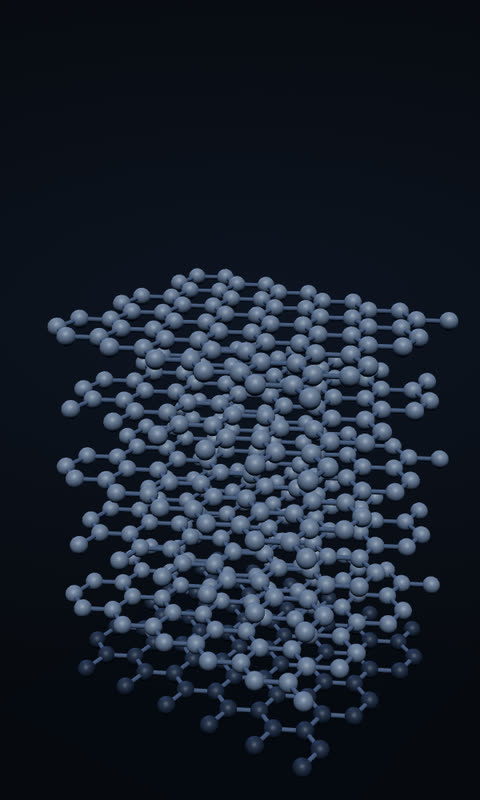
Six graphene layers, all intact.
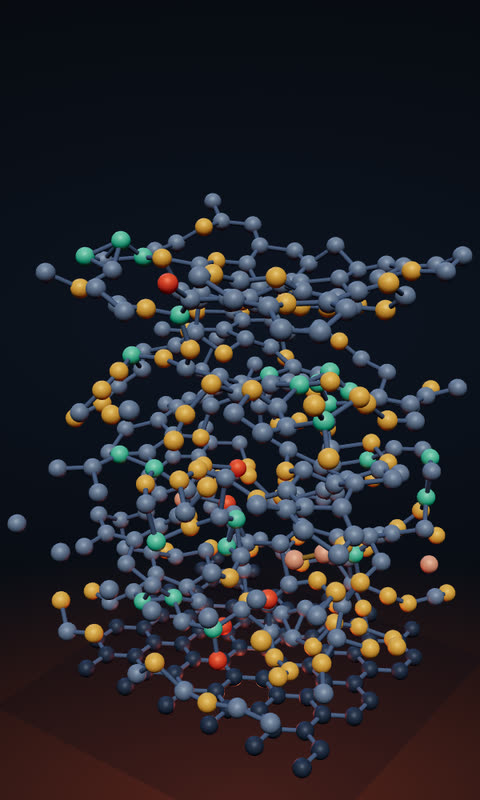
The lattice buckles and chains form. The first fragment broke free at 1.06 ps.
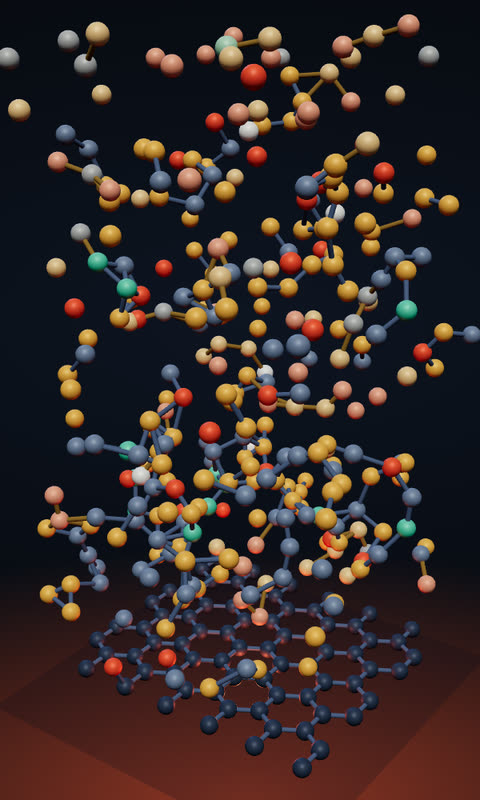
86 atoms float free of the shield. 32 have left the box.
By 4 ps, 41 atoms have left and 40 more float free, 22.5% of the atoms that can move. They leave as chains and clusters. In real carbon vapour, C2 and C3 dominate.
Real graphite sublimes near 4,000 K. Here the first fragment leaves at 7,450 K, since 4 ps is too short to see it happen at 4,000 K. Running hotter makes it about a thousand times faster.
The run
// results/run.json
{
  "model": "orb_v3_direct_20_omat",
  "n_atoms": 432,
  "cell": [14.76, 14.76, 52.75],
  "dt_fs": 0.5,
  "stride": 10,
  "bond_cutoff": 1.9,
  "fragment_max": 8,
  "wall_s": 5965.3
}
Bottom layer of 72 atoms frozen · 300 K, then a 1 ps ramp to 10,000 K, held to 4 ps · 99 minutes on an M2 CPU
Limitations
Real reentry ablation runs on oxygen. The hot gas burns the surface into CO. So we fired oxygen atoms at a 3,300 K slab at 5 and 10 eV.
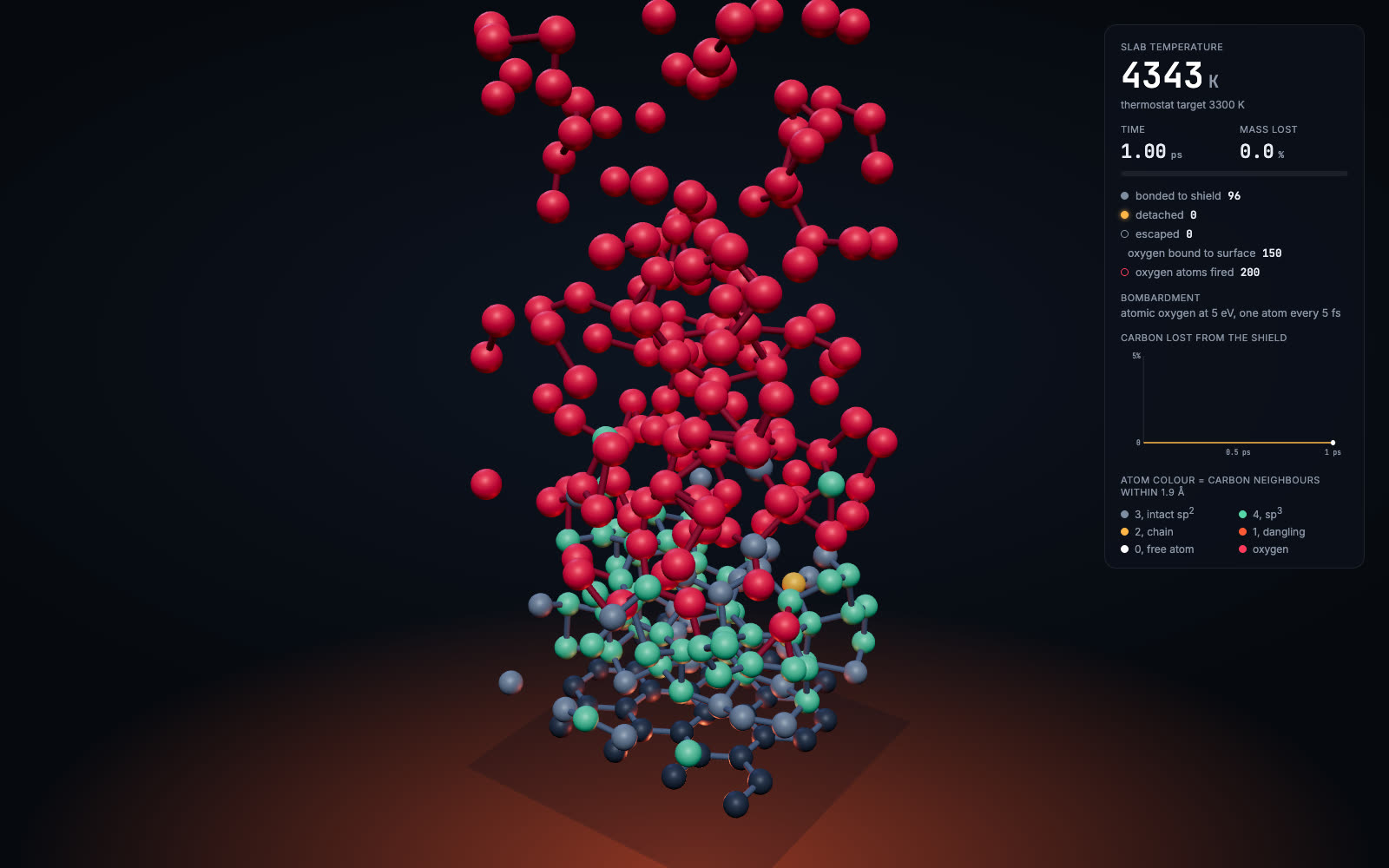
5 eV probe at 1 ps · 200 oxygen atoms fired, 150 bound, no CO
The oxygen stuck, made no CO and formed O2 to O7 chains that glued the layers together. This checkpoint learned from inorganic crystals and doesn't know this chemistry. Don't use it for oxidation. The orbmol checkpoints are next.
Two more caveats. This checkpoint predicts forces without energies, so energy drifts and the thermostat makes up for it. And the slab is an endless sheet with no gas or pressure above it.